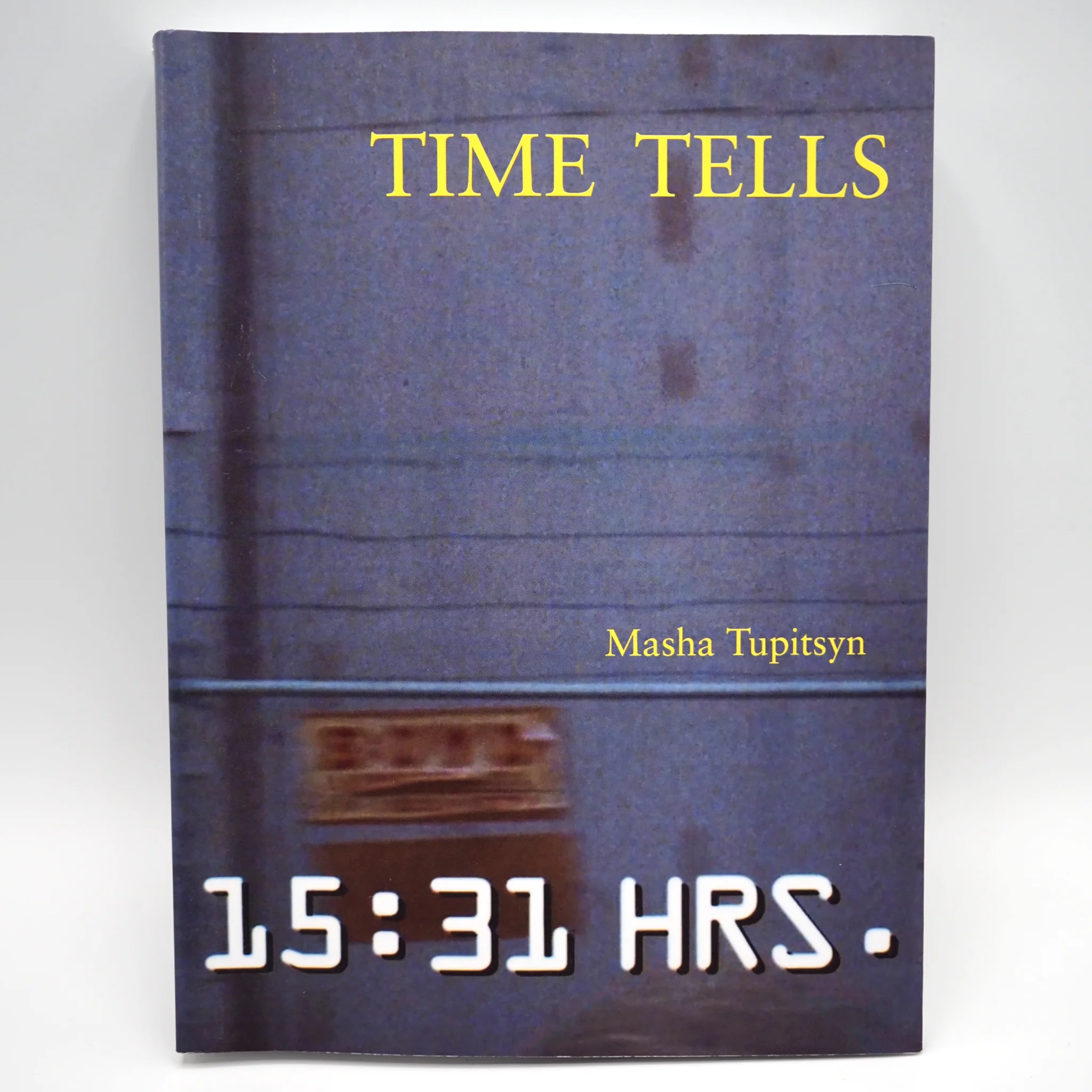
Time Tells - Paperback Book
Published by Hard Wait Press, 2023
Sewn bound softcover with French flaps
First edition of 1,000
296 pages
7.5x5.5 inches
Includes 168 color images
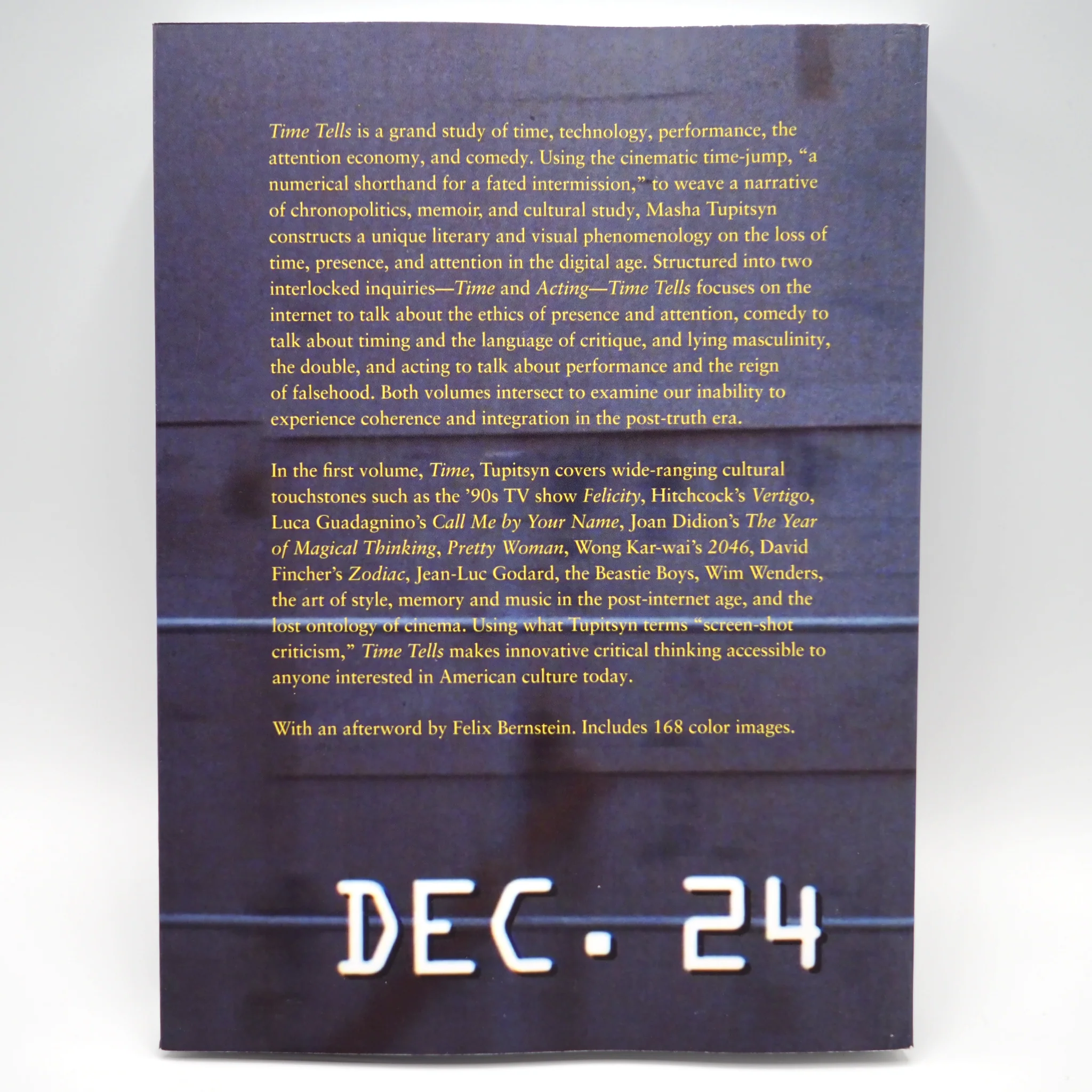
Time Tells is a grand study of time, technology, performance, the attention economy, and comedy. Using the cinematic time-jump, "a numerical shorthand for a fated intermission," to weave a narrative of chronopolitics, memoir, and cultural study, Masha Tupitsyn constructs a unique literary and visual phenomenology on the loss of time, presence, and attention in the digital age. Structured into two interlocked inquiries—Time and Acting—Time Tells focuses on the internet to talk about the ethics of presence and attention, comedy to talk about timing and the language of critique, and lying masculinity, the double, and acting to talk about performance and the reign of falsehood. Both volumes intersect to examine our inability to experience coherence and integration in the post-truth era.
In the first volume, Time, Tupitsyn covers wide-ranging cultural touchstones such as the ’90s TV show Felicity, Hitchcock’s Vertigo, Luca Guadagnino’s Call Me by Your Name, Joan Didion’s The Year of Magical Thinking, Pretty Woman, Wong Kar-wai’s 2046, David Fincher’s Zodiac, Jean-Luc Godard, the Beastie Boys, Wim Wenders, the art of style, memory and music in the post-internet age, and the lost ontology of cinema. Using what Tupitsyn terms “screen-shot criticism,” Time Tells makes innovative critical thinking accessible to anyone interested in American culture today.
Afterword by Felix Bernstein.
“Time Tells is a mesmerizing work about art, life, chronology, and magical thinking. Masha Tupitsyn is a treasure.”—Matt Zoller Seitz
“Masha Tupitsyn rescues films of our generation from the memory hole to which everything but box office is now consigned. Her writing is intimate and analytical, laced with radiant perceptions about movie stars, memory, and lost time.”—A. S. Hamrah
“I have been searching for books during the pandemic that will saddle up with me in my middle-aged sorrow. A sorrow having something to do with “before television went online, days of the week mattered.” Books about the state of the global crisis haven’t done it for me. Masha Tupitsyn’s Time Tells is the book I am looking for. I’m keeping that in the present tense to suggest my ongoing and vital relationship to an extraordinarily generous and profound hybrid text and manual that I will keep on hand at all times. As a poet, I am obsessed with how art can sequence events to expand or contract our sense of time. Mid-way through Tupitsyn’s treatise, she has placed one of the brightest and most innovative pieces of film criticism I have ever read. I would teach her writing on the film Zodiac as a list poem. She writes, ‘In Zodiac, time is forensic.’ I gasped with a little horror and a little joy.”—Stacy Szymaszek
“The first volume of Time Tells is a passionately cresting dispatch. A bittersweet treatise and cri de coeur that serves as both a critical corrective and meaningful demonstration of accumulation and assemblage in an age of endless End times. It provides much sought succor for someone like myself, who was minted in what this cultural critic calls “the last generation of memory” (1980s). Every encounter I have ever had with the warm-blooded thinker that is Masha Tupitsyn has been enlivening and has always given me much to mull, and this vibratory reading is no different. It has long been high time she was granted an expansive platform for these unfolding volumes.”—Douglas A. Martin, Acker, Once You Go Back, and Outline of My Lover
“I really love Time Tells. It's important and wise and complex and poignant. With a rigorous attention to the assumptions and glitches built into the structures of film, technology, and the human experience of time, Masha Tupitsyn has not only created a form large and varied enough to contain time’s saddest and most terrifying questions, she has set them against each other for the post-digital age. What has happened to time? What has happened to memory? What has happened to faces, emotions, breathing? What are we seeing? What is being done to us? What are we doing to ourselves? What has happened to us? Where did we go? Playful and profound, meditative, and fully engaged with this breathless present, the first volume of Time Tells begins a crucial investigation into what we've lost, what we're still losing, and how to reimagine a contemporary experience of time.”—Stephen Beachy, Glory Hole, Boneyard, No Phantom/No Time Flat
MASHA TUPITSYN is a writer, critic, and multi-media artist. She is the author of several books, most recently Picture Cycle (Semiotexte/MIT, 2019). Her films include, the 24 hour Love Sounds (2015), DECADES, an ongoing film series, The Musicians (2022), and Bulk Collection (2022).
Original: $26.00
-65%$26.00
$9.10Product Information
Product Information
Shipping & Returns
Shipping & Returns
Description
Published by Hard Wait Press, 2023
Sewn bound softcover with French flaps
First edition of 1,000
296 pages
7.5x5.5 inches
Includes 168 color images
Time Tells is a grand study of time, technology, performance, the attention economy, and comedy. Using the cinematic time-jump, "a numerical shorthand for a fated intermission," to weave a narrative of chronopolitics, memoir, and cultural study, Masha Tupitsyn constructs a unique literary and visual phenomenology on the loss of time, presence, and attention in the digital age. Structured into two interlocked inquiries—Time and Acting—Time Tells focuses on the internet to talk about the ethics of presence and attention, comedy to talk about timing and the language of critique, and lying masculinity, the double, and acting to talk about performance and the reign of falsehood. Both volumes intersect to examine our inability to experience coherence and integration in the post-truth era.
In the first volume, Time, Tupitsyn covers wide-ranging cultural touchstones such as the ’90s TV show Felicity, Hitchcock’s Vertigo, Luca Guadagnino’s Call Me by Your Name, Joan Didion’s The Year of Magical Thinking, Pretty Woman, Wong Kar-wai’s 2046, David Fincher’s Zodiac, Jean-Luc Godard, the Beastie Boys, Wim Wenders, the art of style, memory and music in the post-internet age, and the lost ontology of cinema. Using what Tupitsyn terms “screen-shot criticism,” Time Tells makes innovative critical thinking accessible to anyone interested in American culture today.
Afterword by Felix Bernstein.
“Time Tells is a mesmerizing work about art, life, chronology, and magical thinking. Masha Tupitsyn is a treasure.”—Matt Zoller Seitz
“Masha Tupitsyn rescues films of our generation from the memory hole to which everything but box office is now consigned. Her writing is intimate and analytical, laced with radiant perceptions about movie stars, memory, and lost time.”—A. S. Hamrah
“I have been searching for books during the pandemic that will saddle up with me in my middle-aged sorrow. A sorrow having something to do with “before television went online, days of the week mattered.” Books about the state of the global crisis haven’t done it for me. Masha Tupitsyn’s Time Tells is the book I am looking for. I’m keeping that in the present tense to suggest my ongoing and vital relationship to an extraordinarily generous and profound hybrid text and manual that I will keep on hand at all times. As a poet, I am obsessed with how art can sequence events to expand or contract our sense of time. Mid-way through Tupitsyn’s treatise, she has placed one of the brightest and most innovative pieces of film criticism I have ever read. I would teach her writing on the film Zodiac as a list poem. She writes, ‘In Zodiac, time is forensic.’ I gasped with a little horror and a little joy.”—Stacy Szymaszek
“The first volume of Time Tells is a passionately cresting dispatch. A bittersweet treatise and cri de coeur that serves as both a critical corrective and meaningful demonstration of accumulation and assemblage in an age of endless End times. It provides much sought succor for someone like myself, who was minted in what this cultural critic calls “the last generation of memory” (1980s). Every encounter I have ever had with the warm-blooded thinker that is Masha Tupitsyn has been enlivening and has always given me much to mull, and this vibratory reading is no different. It has long been high time she was granted an expansive platform for these unfolding volumes.”—Douglas A. Martin, Acker, Once You Go Back, and Outline of My Lover
“I really love Time Tells. It's important and wise and complex and poignant. With a rigorous attention to the assumptions and glitches built into the structures of film, technology, and the human experience of time, Masha Tupitsyn has not only created a form large and varied enough to contain time’s saddest and most terrifying questions, she has set them against each other for the post-digital age. What has happened to time? What has happened to memory? What has happened to faces, emotions, breathing? What are we seeing? What is being done to us? What are we doing to ourselves? What has happened to us? Where did we go? Playful and profound, meditative, and fully engaged with this breathless present, the first volume of Time Tells begins a crucial investigation into what we've lost, what we're still losing, and how to reimagine a contemporary experience of time.”—Stephen Beachy, Glory Hole, Boneyard, No Phantom/No Time Flat
MASHA TUPITSYN is a writer, critic, and multi-media artist. She is the author of several books, most recently Picture Cycle (Semiotexte/MIT, 2019). Her films include, the 24 hour Love Sounds (2015), DECADES, an ongoing film series, The Musicians (2022), and Bulk Collection (2022).